Tuesday, June 5, 2012

Making Your Own Green Screen | A Creative Alliance Workshop in Baltimore

My summer education adventures have consisted exclusively of Creative Alliance workshops in Baltimore. The Film, Video and Digital department at the Creative Alliance is truly an amazing resource that grants people of all levels of experience to learn, experiment and participate in the dialogue of film making in Baltimore.

On May 26, 2012 I attended the workshop Green Screen Basics with Craig Herron. With several tubes of PVC pipe, green fleece and the right lighting, we assembled a pretty nifty DIY green screen. Along the way he explained both the high- and low-end options for construction and lighting and the specific corners that could be cut.

As we lit and tested our green screen, Herron emphasized the importance of strong, even light that did not overwhelm or overexpose the screen. He made technical adjustments to his camera, like lowering the ISO to reduce noise, and steadied his shot with a tripod. Lighting your screen and subject separately is important and makes a huge difference once you move your footage into the editing stage.

Once in Adobe After Effects, we learned about the finer details that are often overlooked and how to not settle for "that looks pretty good". As a test subject, I was transported to the Bahamas and layered into a Maryland barn still (video below).

I had never considered the green screen to be such an art or even a real "replacement" for realism. But with the right amount of technical expertise, studio and equipment (DIY or professional), you can accomplish a great deal. Herron himself is working on a film set in the Bahamas - except he is bringing the scenery to his actors in Maryland via several cruises with his wife and the trusty green screen.

Herron will be working on the set of a new indie western film to be shot in Maryland this summer. This film is written and directed by Wayne Shipley and I've been told they are looking for volunteers to be townspeople, help build sets and even audition for some main roles. Herron, in charge of special effects, will be green screening a steam engine from the 1890s into a train station set. Follow the production on Facebook or check out Shipley's other movie Come Hell or High Water on Netflix.

Over these past few weeks, each workshop I have attended has been hosted by a knowledgeable, experienced and generous instructor. These educational opportunities are held in a small classroom and allow you to easily ask questions and interact with your classmates. Take some time to view current workshops online and sign up to support this dynamic Baltimore institution.

PVC Setup

Parts assembled
Hanging the screen (or green fleece).
A light made from PVC, an extension cord,
sockets and an ice cube tray.

Yes, an ice cube tray.

Energy saving light bulbs lower the heat generated,
wattage used and help prevent burns and blown fuses.
Five bulb light for the key light.
Flagpole base.
A critical look at his creation.
PVC tripod - assembly required.
Plugs.
Lighting the screen.
Camera settings.
Clamps are a screen's best friend
(get out of here wrinkles).
Keying out the green in Adobe After Effects.
Tutorial on rotoscoping
(for those with patience).
How did we get into that barn?

Some Resources:


Saturday, October 1, 2011

Baltimore Magazine Cover Shoot on the Boardwalk with Photographer Cory Donovan

I agreed to assist with another Baltimore Magazine cover shoot with the local Baltimore photographer, Cory Donovan. The day of, I picked-up model-for-a-day, Kara, and headed over to meet with Cory Donovan and the other assistant, Talia Scher. 

Amazingly enough, Anthea Thurston and Aimee Lin from Alpha Studio had graciously agreed to be the hair and make-up stylists for the shoot. 

We all gathered at the Baltimore Magazine headquarters for a pre-photo shoot meeting. 

With directions to Cambridge, Maryland we carpooled to the amazing Hyatt Regency resort - they had generously provided space in their spa for us to prepare for the shoot. 

While Anthea and Aimee styled the model - Cory, Talia and I scoped out the nearby Sailwinds Park. There, we discovered the perfect view; an old boardwalk bordered by rocks and water.

As the day moved closer to shoot time, the sun peeked through the clouds to create a beautifully diffused light. Cory shot in both film and digital; this versatility allowed him to get varied exposures of light and really capture the shot, literally, through a different lens.

As the sun threatened to disappear, we moved quickly to get the three required outfit changes and two locations into the day.

Once the sun fell beyond the horizon we packed-up for the day with a real sense of accomplishment. 

Overall, it was an amazing experience with some really talented people. Look out for the July 2012 issue of Baltimore Magazine for the final shot!

Cory Donovan and Talia Scher on location

Can you tell they also model?

The boardwalk

Checking out the view.

Leaving the Hyatt with the model.

Classic Schwinn bike for photo shoot.


Anthea Thurston (right) and Aimee Lin (left) from Alpha Studio

Cory in action!

Test shot with film.

Schwinn.


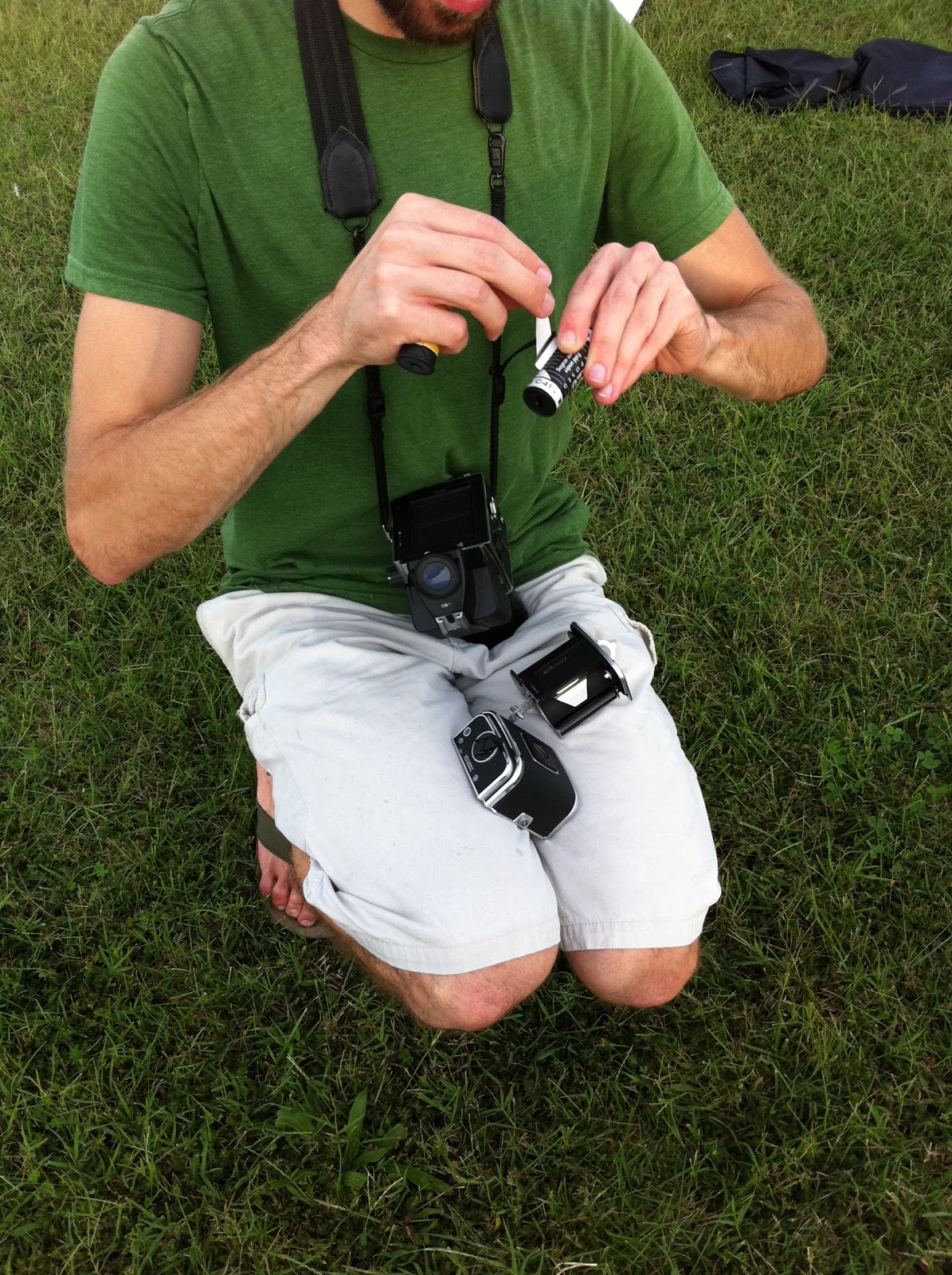
Reloading film.


Giving direction.

Make-up touch up.

Amazing!

Monday, September 12, 2011

Plywood Opening / Jim Lucio: Strip

On Saturday, September 10, 2011 the new gallery opened its doors in at 511 East Belvedere Ave., in Baltimore, Maryland. Plywood is a co-creation by Chris Attenborough and Sean Naftel who are also partners in the artist group Peacock. Occupying a vacant space in Belvedere Square, this new gallery space is available for artists, curators and creatives alike to come together and take advantage of the relatively new, white space:

"Plywood is a new flexible white cube project site located in North Baltimore's Belvedere Square. As part of Roving Project Plywood occupies a currently unused space, transforming it into a space for creative practice. Plywood will only occupy the location until another tenant leases the available store front."www.plywoodsite.org

The gallery opened with a bang with a new show by Jim Lucio. "Strip" is a collection of Polaroids shown consecutively at eye-level around the gallery space. Hung with nails and clips, the photographs create a cinematic effect reminiscent of Tarantino. Passing by, you get glimpses of retro signage and fish nets; clear heels and horror movie imagery captured by instant emulsion.

The photos, a precious collection of a dying photographic art, are not for sale. But, if you're lucky, the gallery may make you an enlarged print signed by the artist. A great idea from a new gallery that is already gaining interest from the artist community.


Thursday, August 18, 2011

Paper and Ink | My day at the printing plant

Recently, I received a personal tour of a local Maryland printing plant. Entering in through the offices, the warehouse space opened-up to a bustling floor of contraptions and weathered tinkerers. The smell of ink emanated from freshly pigmented paper and the floor was clean and bright. Several generations of printers occupied every corner of the space. Metal cans of ink gathered in stadium-seating shelving as a man in a branded blue shirt leafed through Pantone swatch booklets.

Collection of inks.
I enjoyed the overwhelming size of the Komori 5-color process printer. The tall towers housed gooey ink rollers of cyan, magenta, yellow, and black.

Loading paper into one end.
The 5 towers!
The paper moves through the machine.
Prints coming out the other end.
Proofing station to catch any screen errors.
In contrast, the smaller traditional printing machines buckled together like a thousand metal knuckles; punching out pristine white stationary.

My tour guide pointed out the large HP Indigo printer, "digital is the future" he said as we stepped past boxes of fresh prints.

Digital HP Indigo Printer.
5-color process ink with a tube for a PMS ink on the right.
I love ink.
Large and in charge.
Rolls of paper lower costs and increase efficiency.
The more you learn about the other processes that influence your profession, the better you will be at completing your projects at the best price and quality for your client. It's like standing on your head; take a look at things on the other side. Explore new territories and processes and, most of all, have fun!

Monday, July 18, 2011

12 Free Photography Business & Marketing Guides

Today I received a really great email from ASMP providing links to a library of e-books for photographers.

I am currently a member of the American Society of Media Photographers. I highly recommend checking out their website and blog for great resources on anything from copyright to contracts.

The resources below are provided by PhotoShelter (so don't be surprised if you need to fill out a form in order to obtain the book)--providing valuable information is just another way to generate leads!

The entire library of e-books is available here.


What Buyers Want from Photographers
Our 2011 survey of over 500+ image buyers reveals insight into how to best reach them, attract their attention, and keep them coming back for more.
Download this book here.

The Freelancer’s Online Marketing Blueprint
Learn the latest online marketing tactics to attract more potential clients to your website and convert them to paying customers.
Download this book here.

The Photographer’s Guide to Selling Like a Pro
Top salesmen share their advice on cold calling, booking meetings, generating repeat business and more.
Download this book here.

Starting a Photography Business
Start your business with valuable insights from the experts and case studies from six College Photographer of the Year winners.
Download this book here.

Facebook Fan Pages for Photographers
Learn how a build a Facebook Fan Page that can grow your business.
Download this book on the PhotoShelter Facebook page.

Email Marketing for Photographers
Get an introduction to email marketing that includes the metrics that matter, case studies, and how to find an Email Service Provider that can simplify your strategy.
Download this book here.

Inspiration Handbook
Read insights from eight professional photographers on finding and cultivating inspiration.
Download this book here.

How to Sell Prints
The advice and case studies in this guide will teach you how to sell prints by creating an effective marketing plan and selecting optimal merchandise.
Download this book here.

SEO Cookbook for Photographers
Learn the secrets of Search Engine Optimization and how to use them to rank higher on search engines like Google and Bing.
Download this book here.

Photography Blog Handbook
This guide shows you how to use blogs to help grow your website traffic, deepen client relationships, and build a bigger following.
Download this book here.

Social Media for Photographers
A 55-page step-by-step guide that shows how you can use social networks like Facebook and Twitter to succeed online!
Download this book here.

Google Analytics for Photographers
Determine how users are interacting with your website and how this free service can support business decisions and future marketing expenses.
Download this book here.